Fellow Travelers,
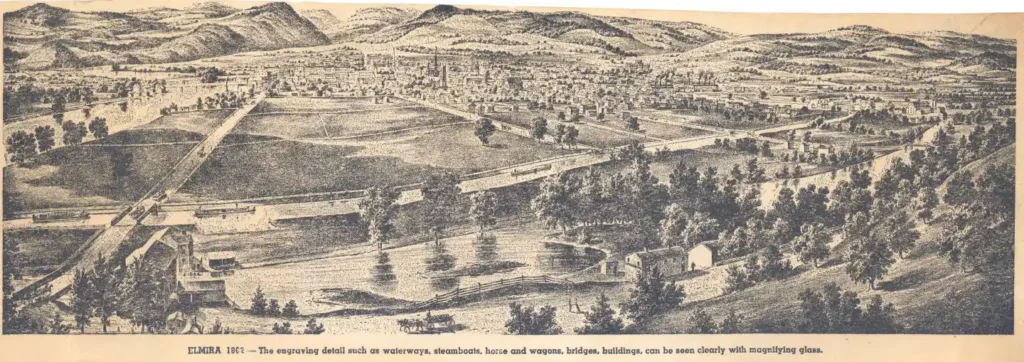
Welcome to early 1861 in Elmira , NY. You have just disembarked from the Elmira & Williamsport Railroad cars and are about to take a whirlwind tour of the town. As we get our bearings, we find ourselves in a relatively small and typical New York State community of roughly 8000. Just a mere 4 miles north of the Pennsylvania border, it is one of the larger towns in Chemung County, although not yet incorporated as a city. Among the many residents that pass us by, are descendants of veterans from the 1779 Sullivan-Clinton Campaign, who returned to the area with land grants as payment for services in the Continental Army.
Passing through town, we skirt the canals connecting Elmira to the Erie Canal, as well as, railroads carrying commodities in all geographic directions. The Chemung Canal links Elmira with the Finger Lakes, Erie Canal and ultimately the Great Lakes & St Lawrence Seaway. The arrival of railroads, established a transportation hub that could take passengers north to Rochester, south to Philadelphia/Harrisburg/Baltimore, east to New York City, and west to Buffalo and the western frontier states.. The packet and bullhead boats, and rail cars busily carry mail, timber, domestic goods, butter and other commodities to eager customers in those locations. The forests have been harvested for the timber and farms now dot the hillsides where sheep outnumber cattle, rye & oats are plentiful.
Walking the streets, we see the offices of two daily and two weekly newspapers, grocers, tobacconists, tailors, milliners, saddlers, and the spires of eight churches. One of those churches was that of Reverend Thomas K. Beecher, brother of Harriet Beecher-Stowe and Henry Ward Beecher (T.K. Beecher’s story will be told at a later date). Several large halls play host to a number of social organizations that drew lecturers and performers from a national pool. From the Elmira Water Cure on East Hill, overlooking the valley, we can see the canal basin and railroad roundhouse supporting an industry base that includes a rolling mill, tannery, soap manufactory and woolen mill.
Continuing our stroll away from the heart of the business district, we approach a pleasant looking knoll, known as Prospect Hill. Upon this hill. we see a distinguished looking building, Cowles Hall, home to the Elmira Female College. The college will become the oldest operating institution of its kind, to originally issue academic baccalaureate degrees to women equivalent to those of men, preceded only nationally by the Mary Sharpe College, which closed its doors in 1890. Founded in 1855, the Elmira Female College graduated its first class in 1859, in the shadow of looming Civil War.
We will have plenty of time to explore Elmira in greater detail in the days to come. Meanwhile, our rooms await us at the Brainard House and get a chance to eavesdrop on the conversations of its patrons.
References:
Barber, W. Charles, Elmira College, The First Hundred Years, McGraw -Hill, NY, 1955.
DeBow, J.D., Statistical review of the United States, A Compendium of the Seventh Census, A.O.P., Nicholson, Washington, 1854.
French, J.H.H., Gazetteer of the State of New York, R.P. Smith, Syracuse, 1860.
History of Tioga, Chemung, Tompkins, and Schuyler Counties, Everts and Ensign, Philadelphia, 1879.
Melzer, Gilbert, The Beginnings of Elmira College 1851-1868, Commercial Press, Elmira, NY, 1941.